

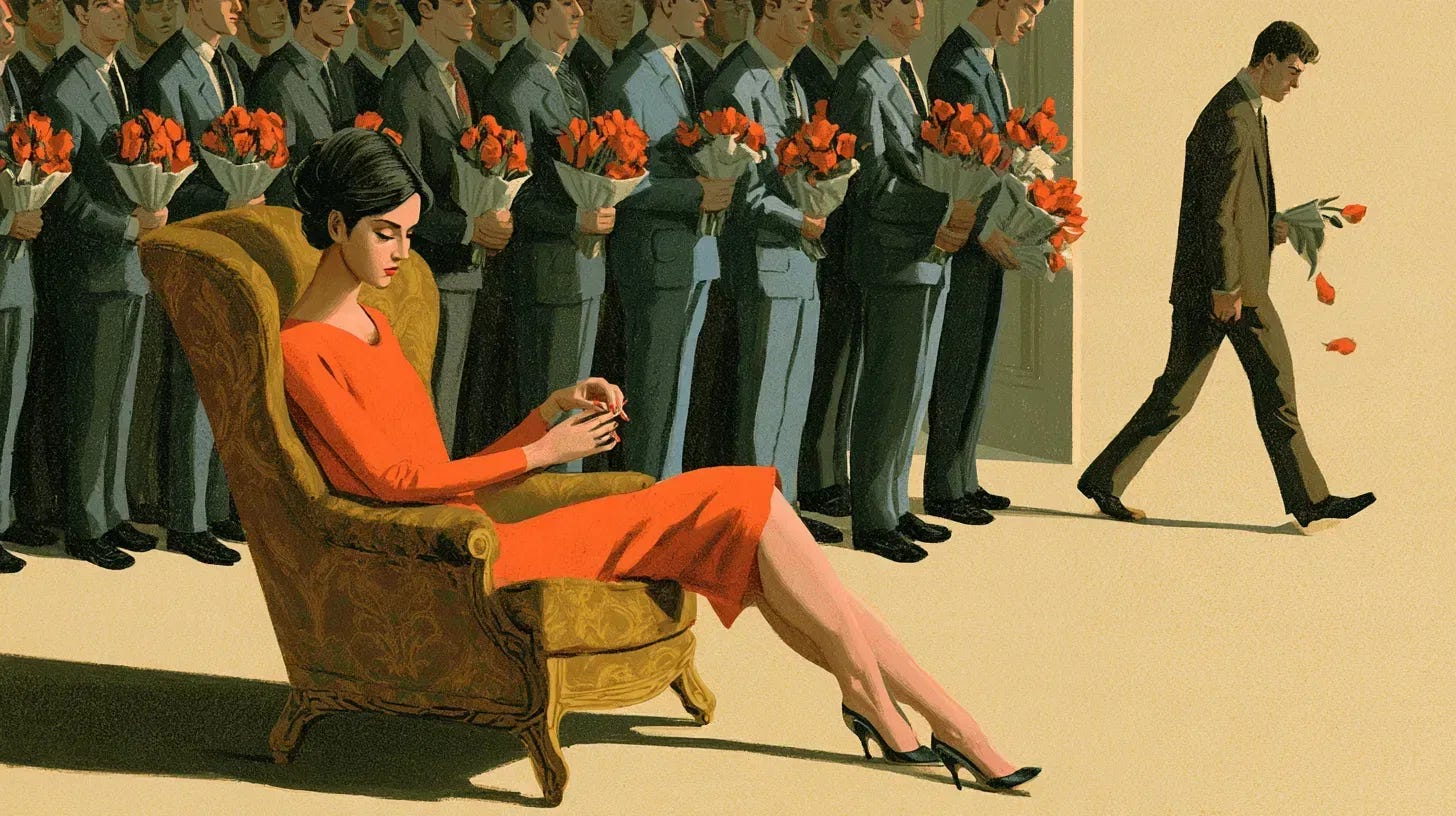
Is it any wonder men are opting out? That’s the question I asked here on Substack last May, describing the young women so many men find on offer in today’s marriage market: “miserable, anxious, politically radicalised, contemptuous of men, often sexually rejecting and trained to see menace in ordinary male behaviour.”
I concluded many men were deciding these women were not worth having, with pollsters finding many young women distrust men and see them in a negative light: “They arrive at relationships pre-loaded with grievance, fluent in the language of red flags and emotional labour, primed by algorithms that have fed them a diet of male failure and female outrage since adolescence. They are, by their own account, anxious, miserable and politically furious.”
That article, explaining why so many men are losing interest in both work and marriage, was viewed over 86,000 times. My comments were filled with men saying, “Yes. That’s me.”
But one question kept nagging at me. How did we get here? How did a generation of young women become so angry, so anxious, so hostile to the very men they claim to want?
There’s no shortage of theories. Social psychologist Jonathan Haidt blames the smartphone: girls’ anxiety and depression began soaring around 2012, just as Instagram took hold. Others point to the pandemic, to economic gloom, to universities steeping students in grievance politics, to years of #MeToo messaging teaching girls to see menace in ordinary male behaviour.
This is not a private sorrow for a few unlucky individuals. It is the slow unravelling of the bargain upon which families, communities and economies have always depended.
All of these play a part. But I want to suggest another factor, one that set the stage long before the first iPhone. Inspired by feminists like Betty Friedan who preached work as women’s salvation, young women were encouraged to put marriage on hold: get the degree, build the career, see the world, settle down later. And so, they did. Without anyone quite noticing, we added an entire decade of dating into young adults’ lives. Then along came the smartphone and the dating apps, and that decade became a brutal marketplace of seeking and rejecting, of dates that go nowhere and breakups that leave scars.
That decade has proved enormously costly, with profound consequences for our societies. Look at what has followed. Marriage – for generations the cornerstone of adult life – is in free fall, the Australian marriage rate more than halved in fifty years. Our birth rate has sunk to 1.48 babies per woman, the lowest ever recorded and far below the 2.1 needed simply to replace ourselves. In the United States, demographer Lyman Stone projects that one in four women now in their thirties and forties will never have children – most of them not by choice. Growing numbers of women will now face old age alone – often lonely, many of them poor. And the men, freed from the yoke of marriage that for centuries harnessed their ambition and their labour, are walking away from work as well as from women. This is not a private sorrow for a few unlucky individuals. It is the slow unravelling of the bargain upon which families, communities and economies have always depended.
Here are some statistics that might stop you in your tracks:
Women in Australia and New Zealand are freezing their eggs at record rates – more than double the number of four years ago, according to ANZARD, the register that tracks every IVF cycle in both countries. Ask the fertility doctors why, and they don’t talk about glittering careers. The answer is much more basic: there’s no man.
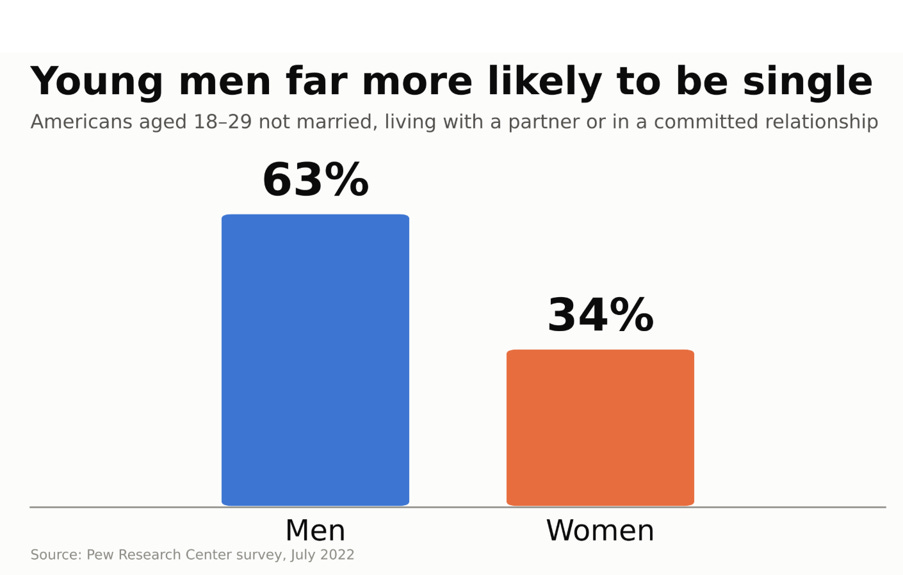
So where are all the men? A lot of them are home alone. The famous 2022 Pew survey found that 63% of American men under thirty were single – up from 51% just three years earlier. Not married, not living with anyone, not even in a relationship. And their female contemporaries? Only a third (34%) are in the same boat. Part of the gap probably reflects young women dating men over thirty – and perhaps some relationships she considers committed, he doesn’t.
(You’ll notice those figures are American. Much of the best research on young people’s love lives comes from the US, because Australia simply doesn’t collect it – there’s no national survey tracking how many young Australians are single or going without sex. But where we do have local figures, on marriage, partnering and births, they point in the same direction.)
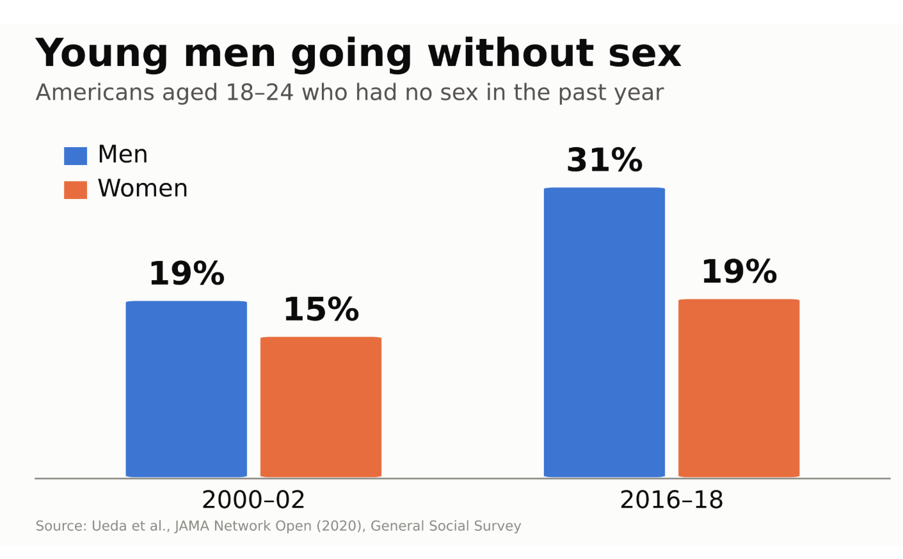
Next, you can forget the image of the swinging bachelor. Nearly one in three young men aged 18–24 (31%) had no sex at all in the previous year, according to a 2020 study using America’s General Social Survey. In the early 2000s it was 19% – so that’s a rise of almost two-thirds. Young women barely budged, from 15% to 19%. Nor is it getting better: by 2024, nearly a quarter of all Americans under 30 had gone the whole year without sex, double the share in 2010. So much for the sexual revolution.
Remember that decade of dating? Here it is in black and white. In 1974, the typical Australian bride was 20.9 – barely out of her teens. Today she’s 30. Her groom has gone from 23 to 31. Even the Australian Bureau of Statistics, looking back in 1997, put the delay down largely to women’s rising participation in education and work: “The extra time it took to achieve these goals was probably a major factor leading to the postponement of marriage.”
So, who actually ends up living with a partner – and when? The 2021 Census tells a striking story. In their late twenties and early thirties, women are well ahead: 61% of those aged 25–34 live with a partner, compared with just 52% of men. But then comes the great reversal. By 35–44, just as the fertility window is slamming shut, one in four women isn’t living with a partner. From there the lines cross. Men hold steady, while women slowly slide. It looks like the nice guys that women passed over at 25 have found their feet, built their careers – and many of them now have options. Including younger women.
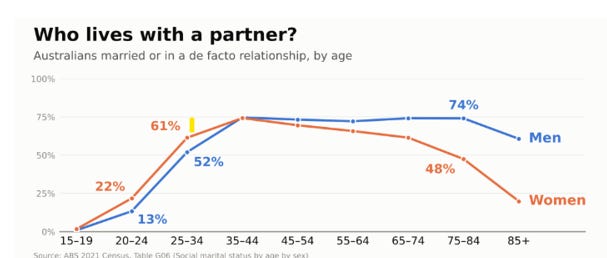
Some will say young people haven’t stopped partnering – they’re just living together instead of marrying. And for many, particularly in less well-off communities, living together has indeed replaced marriage – though these relationships are far more likely to break up. But even counting de facto couples, the decline is dramatic: in 1976, 59% of women aged 20–24 lived with a partner; by 2021 it was just 22%. For young men, it fell from 32% to 13%. Cohabitation hasn’t filled the gap.
Some of this I saw coming. Fourteen years ago, in my Sydney Morning Herald article called “Why Women Lose the Dating Game,” I quoted an American blogger, Dalrock, who summed it up perfectly: “Today’s unmarried twentysomething women have given men an ultimatum: I’ll marry when I’m ready, take it or leave it.”
Even then, plenty of men had decided to leave it. I wrote about the astonishment of successful career women who finally felt ready to settle down, only to look around and find the men had gone. The newspapers were full of anguished essays from thirty-something women stranded on the shelf, wondering where all the good men were. My question was simple: had this female-led decade of dating been a strategic blunder?
Fourteen years on, the answer is in – and it’s worse than I thought. The cost hasn’t just fallen on women left high and dry in their thirties. Men and women alike emerge from a decade of seeking and rejecting partners battered, bruised and wary. And a growing number simply give up – spending some of the best years of their lives alone.
Which is where Ali Mahmoudiyan comes in…
Ali Mahmoudiyan, 27, has a fascinating story. He grew up in a devout Shia Muslim family in Tehran, in a culture where, as he puts it, “most people in my parents’ generation married without ever having touched each other.” There were no boyfriends or girlfriends, no dating, not even friendships between young men and women. As a teenager he clung to the idea of the West – “the hope that somewhere out there, a better world was possible.” At almost 21, he arrived in Europe.
Germany was meant to be the promised land. Instead, he was shocked to discover that most young people seemed “to suffer more from dating than they benefit from it.” “They hurt each other – sometimes deeply, even traumatically,” he writes. “Many appear to be drowning in the very freedoms they’re supposed to be enjoying.” He was particularly struck by how badly young men were faring, in a society that sometimes seemed “to show more empathy for livestock than for its own men.” Yet the women didn’t seem much happier: “The average German woman enjoys comforts and freedoms that would have been the end-game dreams of my sister and my mother. Yet I still couldn’t tell you which of them seems, in the end, to feel more miserable.”
His own first relationships sent him searching for answers. “At some point I found myself asking: what the hell is going on here?” Now studying for a master’s in sociology at the University of Leipzig, he has spent the past few years working on the manuscript for a future book, Modern Intimacy, on the hidden costs of the modern dating market, particularly for young men.
Ali pulls no punches. “For young men, the dating market is psychologically violent,” he writes, “and those wounds often shape their entire adult lives.” It’s a market he describes as “ruthless, often emotionally violent,” in which “the average young man feels – consciously or not – how deeply disadvantaged he is. That injustice is not abstract. It hurts.”
Part of the problem is simple arithmetic. The dating apps are flooded with young men – on Tinder, they often outnumber young women two to one. So, women have what Ali calls “the perception of an oversupply of men”, while the men scramble for the scraps. Even in the real world, he notes, “young heterosexual women receive enormous attention – from all directions, from all age groups. Whether it’s on the street, at work, in the gym, or on dating apps, the demand is immense.”
On the apps, the imbalance is staggering. “The average woman on a dating app receives maybe 10 to 50 likes per day,” Ali writes. “What most women don’t realise is what the average young man experiences. It’s… crickets.” The typical young man, he says, “would be lucky to get one match per week. Yes, you read that right. Per week.”
But here’s the twist: all that attention is a two-edged sword. When a young woman is flooded with dozens of eager men, Ali says, “paralysis sets in. You don’t even know where to start.” For women, he concludes, “selection becomes the primary burden rather than rejection.”
And the constant flood takes its toll. Ali argues that endless validation leads to “desensitisation, higher selectivity, short-term excitement-seeking, and long-term dissatisfaction. Paradoxically, more options often result in less happiness.” Healthier partners, he says, start to feel boring.
This puts enormous power in women’s hands – what Ali calls #FemaleChoice. “For women… the challenge is deciding. They must sift through a wide pool of offers. For men… the challenge is waiting.”
What makes this so painful for men is what Ali calls the “female emotional monopoly.” Women have increasingly become the “gatekeepers” of emotional intimacy. “For many men, romantic-sexual relationships are the only place where vulnerability feels possible.” Most men, he says, “have no safe places to talk about their feelings, to be emotionally vulnerable, or at least to receive a warm, loving touch on their skin, except within romantic or sexual partnerships.” So, for men, finding a partner isn’t just nice to have – it’s emotional survival. And that hands women all the bargaining power. “Women, in this market, hold two distinct ‘advantages’: the emotional monopoly and the perception of an oversupply of men.”
And boy, do some behave badly. I had a very entertaining week before my video chat with Ali Mahmoudiyan, watching some of the feisty women now calling out the behaviour of their own sex in the dating game. Women like Hannah Spier, the Switzerland-based anti-feminist psychiatrist I interviewed last year. On YouTube she recently took apart the dating coaches and influencers teaching young women how to become a “High Value Woman” – which, Hannah points out, is really a how-to guide to becoming a narcissist. Look at these women.
Hannah’s verdict? It’s a way to “lure men into their trap and then drain him like a vampire” – treating men “with the same consideration as gum stuck under their shoe.” Grim stuff, eh?
I talked with Ali about much of this – please circulate our video discussion and take a look at his Substack, where he’s posting articles related to his work. He brings something rare to this debate: a young man willing to speak openly about his own heartbreak, and an outsider who grew up in a world where dating didn’t exist, now looking at ours with fresh eyes.
His most important insight is about what that decade does to young men. Years of invisibility and rejection leave scars that don’t simply vanish when their fortunes turn in their thirties. Imagine finally meeting “a wonderful woman who might never have paid attention to you ten years ago,” Ali says. “But if you are still bringing all the bitterness, the invisibility, the rejection and the painful experiences of your twenties into that relationship, it’s not a recipe for a healthy relationship either. It’s simply a lose–lose situation.”
Fifty years ago, we told young women to put marriage on hold but never stopped to ask what that would do to their chances of finding love, marriage, kids – the whole shebang. Writing for The Weekend Australian last week, Louise Perry points to what’s been called a “relationship recession”, with young men and women living ever lonelier lives. Interestingly, she suggests it may also explain why the sexes are pulling apart politically: they no longer “deradicalise each other through sustained, loving relationships.”
What’s extraordinary is how little attention we have paid to these issues. We’ve rewritten the timetable of young adults’ lives and barely anyone has stopped to ask the cost. We fret endlessly about falling birth rates, male disengagement, the epidemic of loneliness and the growing political divide between young men and women yet rarely connect the dots. One of the biggest social experiments of our time is unfolding in plain sight and we’ve hardly noticed.
I think there is another explanation missing here, and game theory provides a rather good one. It also explains why men can withdraw from dating without ever having experienced the years of rejection, emotional damage or bitterness described in the article.
The first mistake is assuming that the women experiencing the consequences are necessarily the women responsible for creating the conditions. They aren't. In fact, they don't even need to be a significant proportion of the population.
In game theory, the rules of a game apply to everyone, regardless of who wanted those rules in the first place. It only takes a relatively small number of participants capable of imposing a sufficiently large cost on others to change the behaviour of the entire population.
Consider a simple example. Suppose 99 women out of 100 are perfectly reasonable, welcome male attention and have absolutely no intention of causing trouble. The remaining one may interpret an unwanted approach as harassment, make a complaint, or create a public accusation. The man approaching a stranger has no reliable way of knowing which one he's dealing with.
More importantly, he doesn't need to believe that most women are dangerous. He only needs to consider the probability of a sufficiently expensive outcome.
This is where the asymmetry becomes important.
For a man initiating contact, the potential reward might be a pleasant conversation, a phone number, perhaps eventually a relationship. The ordinary negative outcome is rejection, which is hardly catastrophic. But depending on the circumstances, there may also be a small probability of something considerably more expensive: reputational damage, a workplace complaint, an investigation, public humiliation, or consequences for his employment.
These outcomes aren't equally likely, and an ordinary invitation isn't automatically harassment. That's not the point. The point is that the potential downside can be radically disproportionate to the reward, particularly when the man cannot reliably estimate either the probability or the consequences.
Take an illustrative game where participation offers a potential benefit worth $100, but carries a 1% probability of a $20,000 loss. That risk alone has an expected cost of $200. Even before accounting for ordinary rejection, the expected return is negative.
And before someone objects that the numbers are invented, of course they are. They illustrate the mathematics, not the actual probability of complaints. The argument depends on the structure of the payoffs, not those particular figures. A much smaller probability can produce the same result if the potential loss is sufficiently large.
Now consider who actually needs to change for this to happen.
Not the average woman. Not even the women interested in finding partners.
The perceived risk may be shaped by legislation, institutional policies, media coverage and public narratives. Feminist organisations and campaigners have influenced some of these developments, but that doesn't mean ordinary women collectively designed them, supported them or even understand their consequences.
The media can be particularly influential here. A relatively rare event receiving enormous publicity can affect perceived risk far beyond its statistical frequency. People make decisions using the information available to them, and they are especially sensitive to low-probability events with potentially irreversible consequences.
The man doesn't need to personally encounter a malicious accusation. He can observe what happens to someone else, assess the institutional environment and decide that participation is not worth the exposure.
This is an important distinction because the article treats male withdrawal largely as the result of accumulated rejection and emotional injury. Years of being ignored or treated badly eventually leave men bitter and unwilling to try again.
That undoubtedly describes some men. But game theory predicts another group entirely: men who never entered the market, or who exited before anything particularly bad happened.
They aren't necessarily wounded, angry, frightened or socially incompetent. They simply don't consider the expected return attractive enough to justify participating.
We see this reasoning everywhere else. People decline investments with an unfavourable risk/reward ratio. Businesses refuse contracts with excessive liability. Professionals avoid transactions where the potential exposure is vastly greater than the fee. Nobody assumes they must have suffered some psychological trauma to reach those decisions.
Yet when a man declines to pursue women, the explanation suddenly becomes his confidence, social skills, fear of rejection or inability to handle modern relationships.
Perhaps he has evaluated the game and decided not to play.
There is also a distinction between actual risk and perceived risk. A legal protection against harassment doesn't itself make ordinary flirting unlawful. But if men cannot confidently distinguish acceptable behaviour from behaviour that might generate allegations or institutional consequences, uncertainty becomes another cost. Media narratives can amplify that uncertainty without any corresponding change in the law.
And the effects aren't limited to workplaces or dating apps. Once someone develops a general expectation that initiating romantic contact carries asymmetric risks, he may apply that expectation in settings where the actual risk is considerably lower.
This is also why telling men that most women are decent doesn't necessarily solve anything. Most probably are. But the decision is made before a man knows which individual he is dealing with, and the potential consequences are not evenly distributed.
The result is a negative externality. A relatively small number of people, combined with the surrounding institutional and cultural environment, can influence the behaviour of millions. Women who have never supported the relevant policies or narratives may find themselves receiving less attention, fewer approaches and fewer opportunities to form relationships. They bear some of the costs without having contributed to their creation.
There is another interesting consequence. The men most sensitive to reputational and professional risk may be precisely those with something substantial to lose. A man with an established career, financial responsibilities and a reputation worth protecting has stronger incentives to avoid uncertain exposure than someone with very little at stake.
So withdrawal doesn't necessarily select for men who are undesirable or unsuccessful. Under certain payoff structures, it can select for the opposite.
This creates a collective problem. Individually rational decisions can produce a result that almost nobody wants. Men stop initiating, women who would welcome those approaches stop receiving them, and both sides wonder why relationships have become harder to establish.
No conspiracy, coordinated boycott or collective male decision is required. Each man can arrive at the same conclusion independently.
And notice that none of this requires hostility towards women. A man can like women, enjoy their company, find them attractive and still choose not to turn those interactions into romantic pursuits. Attraction and willingness to accept risk are separate decisions.
This is why I think the explanation in the article is incomplete. It concentrates on what a decade of unsuccessful dating does to men psychologically, while paying much less attention to whether the conditions of the game have changed enough to discourage participation in the first place.
If men are leaving because they are emotionally wounded, perhaps confidence, counselling or better dating experiences might bring them back.
If they are leaving because they perceive the game as structurally asymmetric, none of those things changes the calculation.
You cannot repair an unfavourable payoff structure by telling participants to become more confident.
And the particularly unfortunate part is that the ordinary woman looking for a relationship may have had absolutely nothing to do with any of this. She can be reasonable, interested and perfectly approachable, yet still experience the consequences of a system that discourages men from making the first move.
That is what makes the game-theory explanation worth considering. The people who influence the rules, the people who create the risks and the people who ultimately pay the price don't have to be the same people.
The article asks what happened to men after years of dating.
I think we should also ask how many looked at the rules, calculated the risks and decided there was no good reason to start.
Thank you so much, Tina, for the wonderful conversation!
And thanks to everyone for watching our video! Feel free to share your thoughts or ask questions here in the comments or on my own Substack. I'll read every single comment and try to respond to as many as possible.
Cheers,
Ali