
Rapists or wrongly convicted
- Are Australia’s rape reforms sending innocent men to jail?


Three years ago, Sydney engineer Aaron Peapell was accused of a home invasion — “aggravated break and enter with intent to commit a serious indictable offence.” His intent was rape, according to police. He’d never even met the woman who accused him, and police showed no interest in his irrefutable evidence that he couldn’t have done it.
They tried to put him away for 20 years. He self-represented through 20 court appearances, won twice in the District Court — with costs against the Crown — and then again when the DPP’s appeal failed, achieving another costs order, in a case significant enough to make the NSW Law Reports. Remarkable, for an unrepresented litigant.
As he said in his first letter to me, these wins prove the case was unfounded — “[the cases] prove I am innocent apparently.” But, he added, “I don’t feel innocent.”
The toll has been enormous:
“I am not sure what broke me in the end. Standing in court, shaking, facing a 20-year jail sentence, representing myself? Standing in front of 3 x judges in the NSW Court of Appeal? The weight of 3.5 years of unrelenting litigation? The hospitalisation due to stress? Running out of money and no longer being able to work? Uncontrollably crying for 2 days after I was found innocent? Living in my car for 12 months just to be able to represent myself in appellate courts?”
“I think I lost different parts of me along the journey and now no longer recognise the skydiving, international jet-setting playboy I used to be, because that man no longer exists.”
This is the story we never hear — the tremendous cost to innocent men fighting false rape allegations, even when they’re ultimately vindicated. The public narrative is entirely captured by persistent complaints about the justice system’s treatment of rape victims. There’s little tolerance for muddying the waters by looking at what the same system does to wrongly accused men.
Last year, a two-year inquiry run by the Australian Law Reform Commission (ALRC) found that the system “is not supporting those who have experienced sexual violence to seek justice, nor holding those who use sexual violence to account.”
The reforms are already rolling out — new services, new powers, new pressure on every state to fall in line. All of it aimed at supporting survivors. None of it asking what it costs the men standing in the dock, whose right to a fair trial is quietly being worn away in the name of getting more convictions.
A staggering 67% of all costs certificates in assault cases are now due to sexual assault matters. That’s more than double just three years earlier, in 2019/20, when sex crimes accounted for a mere 28% of the total.
What no one talks about is the fact that our justice system is already failing accused men — and taxpayers are footing the bill. The proof is in the frequency of what are called costs certificates.
When a judge grants a costs certificate, it means one thing: a court has found that, on the evidence available at the time, the prosecution should never have gone ahead. The accused person’s legal costs are then reimbursed — out of the public purse. Each certificate is an official admission that a man was put through the ordeal of a sexual assault trial the Crown should never have brought.
The latest available NSW figures, from 2022/23, show that a staggering 67% of all costs certificates in assault cases are now due to sexual assault matters. That’s more than double just three years earlier, in 2019/20, when sex crimes accounted for a mere 28% of the total.
Costs certificates for assault matters are becoming rarer overall — prosecutors, it seems, are getting better at not bringing weak cases. Sexual offence matters are the exception.
The financial cost to the state isn’t huge, but it speaks volumes about this overlooked corner of injustice. Far more significant is the damage these cases do to the public’s faith in a fair justice system. And the toll on the men who live through them — and their families - as the steady stream of letters I receive makes clear.
Given how rarely these cases get any public attention, it is worth sharing a small selection, both in this blog and in my new podcast, which features some of these men describing their ordeals. Please help me circulate the podcast, available on YouTube and soon on Spotify.
I’ve told you about Aaron Peapell.
Now comes Alan’s story. (His name and some key details are disguised for legal reasons.) Alan spent three years in prison, following a sexual assault allegation from a 14-year-old girl who was a foster child living with his partner. Soon after he was convicted, his lawyer received a letter from a member of the jury that had convicted him, pleading that he appeal the decision. Here it is:
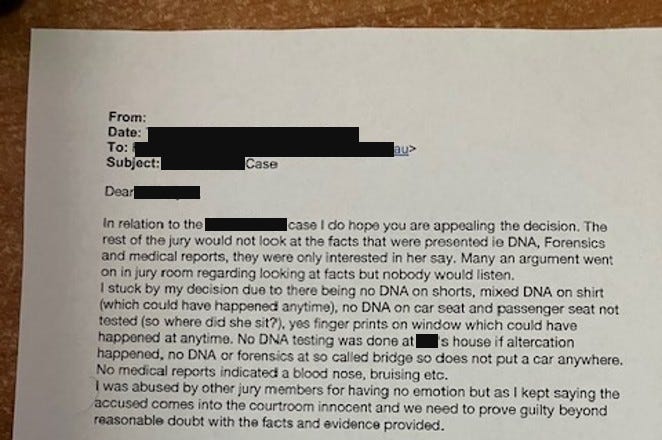
It has to be said: every sexual assault allegation deserves to be taken seriously, and when the alleged victim is a child, a jury will inevitably feel the weight of that. But feeling that weight is exactly why the presumption of innocence exists — as a safeguard against verdicts driven by how a case feels, rather than by what the evidence actually shows.
That’s what makes this juror’s letter so striking. It’s a raw, frustrated account of a lone voice trying to hold the rest of the jury to that standard — and being abused for it. The rest of the jury, the juror wrote, “would not look at the facts that were presented i.e. DNA, Forensics and medical reports, they were only interested in her say... nobody would listen.” The juror held out: “I was abused by other jury members for having no emotion but as I kept saying the accused comes into the courtroom innocent and we need to prove guilty beyond reasonable doubt with the facts and evidence provided.”
The evidence given in Alan’s case, as laid out in the appeal documents, was extraordinary. Asked directly whether Alan had touched her, one exchange ran:
Q. Did (the accused) touch your vagina through your pants, true or not true?
A. True, true, not true who knows. Who fucking knows.
The complainant, who had a documented history of mental health issues, gave evidence a court-appointed expert described as riddled with “outbursts, swearing, refusing to continue with her evidence.” She had “a tendency to behave in a certain way when she had not taken her medication, to run away from caregivers and be violent towards them, to make false allegations against caregivers and to self-harm.” That history never reached the jury.
Even the trial judge struggled to watch it unfold, telling the court mid-trial: “I’m deeply troubled that this young person clearly does not want to be there... how, unless things improve, the Crown can rely on this material to sustain verdicts of beyond reasonable doubt, is very difficult for me to see.” The Crown Prosecutor himself all but agreed: “I’m not sure if the complainant’s evidence does get much better. She does become much more frustrated.”
Her account also multiplied with each telling — a touch to the leg became a touch to the leg and the vagina; one injury became three. And one claim collapsed entirely: she told police she’d spotted rope at the scene — implying Alan might have done this before. Police body-worn footage showed otherwise. No rope was ever pointed out; none was ever photographed. It was a fabrication.
Yet he was convicted, and spent the next three years inside, of a 5½ year sentence. There are real questions as to whether his lawyers made the right decisions — they’d assumed there was no need to put Alan on the stand, nor call his witnesses, because the complainant’s evidence was so thin. His appeal was unsuccessful. Alan wants the world to know what happened to him — and I am happy to have him on my podcast to try to make that happen.
Then there’s Martin, a Sydney man who made the fatal mistake of renting out rooms in his house to two young women who cooked up an extortion plot to get free rent from him by threatening a rape complaint. There are text messages from one of them, let’s call her Minx One, coaching the other on how to sell it: “Just act scared,” she wrote. “Like you’re traumatised.”
Minx One had her own reasons to want Martin to suffer. She’d been his lover once, and was furious he wouldn’t marry her — furious enough, allegedly, to help engineer the whole complaint. Martin paid for it with 34 days in jail.
And it gets crazier. Another man in the house that same night was separately charged by the same complainant, for conduct allegedly occurring in the same bedroom, an hour or two earlier. He was convicted — but ultimately won his appeal and walked free.
There’s more. So much more. The police body-camera footage from the night of the raid? Gone — “inadvertently deleted,” the police said. Martin returned from custody to find his pillow with “rapist” scrawled on it, his sheets with “YOU BELONG IN JAIL“ and “YOU DISGUST US!”
Eventually it landed in the District Court, where Judge Wass SC found the complainant’s credibility “very substantially lacking,” and identified “a clear motive to lie to obtain financial compensation.” Had the prosecution known then what the evidence later showed, she found, it would never have been reasonable to bring the case at all. “It was not reasonable to commence, much less continue the prosecution,” she concluded — and granted Martin one of those rare costs certificates.
So how did the prosecution not know all the relevant facts? That’s on the sexual assault squad that investigated it — the same outfit that lost the police videos, deleted the footage, and never once looked hard at the story from the accused’s side. This is precisely the type of evidence the Law Reform Commission chose not to go near.
Martin has his costs certificate. He’s now planning to run a civil suit against police and the DPP for malicious prosecution.
Now these are exotic cases, each one so unbelievable that they leave us scratching our heads that our feminist-led prosecutors had the audacity to run them in court. But I could have shown you any number of the everyday cases now choking our justice systems — usually featuring young men who annoy their partners by not being interested in a relationship or wanting to break up with them. And the women take vengeance by sending them to jail. Doesn’t that leave you reeling?
Listen to Paul. He was a university administrator before finding himself carted off to Long Bay Jail on a rape charge. He was nervous about telling the tough inmates what he was in prison for but when he said he had been accused by his girlfriend, they gave him knowing looks and left him alone. “Oh, the old Saturday night set up,” quipped one of the prison lawyers when Paul explained his story.
“I could not believe what had happened to me. When the cops fronted me, I said incredulously, ‘You’re kidding!?’ I was so shocked that she would make up that bullshit to punish me for ending the relationship. She was a young single mother, living with her parents and saw me as the ticket out of what had been a very rough life. It was revenge.”
Paul’s story contains many lessons for all the men who believe it will never happen to them. I’ve invited him onto the podcast so he can share vital information about what men need to know: about cops fabricating or ignoring evidence and coaching witnesses to change their statements, about choosing the right lawyers and making sure they do their job. Whether to take the stand. Handling a cross-examination. About how getting early release requires “accepting your guilt” and attending farcical sex offender programs where everyone tells the psychs what they want to hear.
It has been valuable and important for society to hear from genuine rape victims, and to see them get the justice they deserve. We tell ourselves that believing women protects them. It’s a good instinct, and mostly, it does. But belief without scrutiny doesn’t protect victims — it protects liars, at the cost of the innocent men they’ve accused. And the men paying that price could be your sons, your brothers, your friends.
I had to leave a job recently because it was mandated that I had to pair up with a female colleague to work together
I was very uncomfortable as a male working closely with a female who is also married but had a temper you wouldn’t believe
I would rather leave the job than being falsely accused that I touched her arse or I touched her tits
And then being suspended, etc
Men should be able to refuse to work with females if they feel uncomfortable and unsafe
Without being disciplined by The company
The feminists have turned the legal system into a dangerous joke. It would appear their main aim now is just to jail men. Statute of limitations .. forget it, presumption of innocence ....inverted. How long are we putting up with this corruption? Magistrates, judges, prosecutors and police who pursue these riddled-with-doubt cases, should be jailed themselves for long stints. They're all ignoring our constitutional safeguards. Women get bribed with monetary rewards to railroad men into jail for "intervention order" breaches, god knows what the incentive is for a rape conviction.